
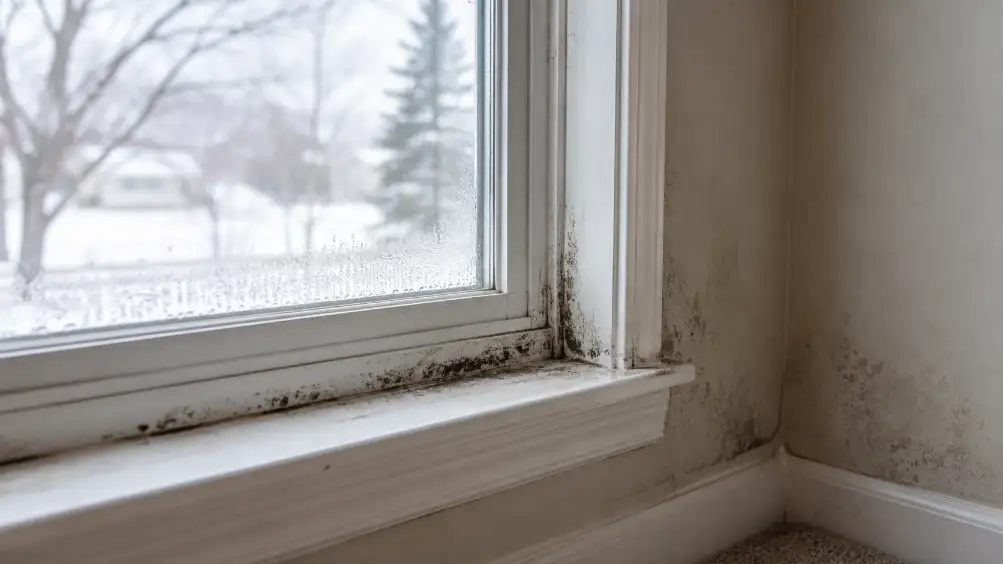
What Causes Mold Around Windows in Northern Illinois Homes?
Mold around windows is usually caused by recurring moisture from condensation, elevated indoor humidity, air leakage, exterior water intrusion, or a combination of these conditions. During cold Northern Illinois winters, warm indoor air can contact cold glass, metal frames, trim, and wall surfaces. When the air cools, moisture may form on those surfaces as condensation.
If condensation repeatedly wets the window sill, wood trim, drywall, caulk, dust, paint, or fabric window coverings, mold may begin to grow. However, not every window mold problem is caused by indoor humidity. Rainwater can enter through deteriorated caulk, failed flashing, damaged siding, roof problems, or gaps around the window opening.
Water entering from outside may remain concealed behind trim, drywall, or insulation. This can allow mold and material deterioration to continue even when the visible surface has been wiped clean.
The correct solution depends on identifying the moisture source. Cleaning visible spots without controlling condensation or repairing an exterior leak may provide only temporary improvement. Recurring growth, soft materials, widespread staining, strong musty odors, or suspected moisture inside a wall should be professionally evaluated.
Quick Answer
Mold around windows commonly develops when condensation repeatedly wets the sill, frame, trim, or surrounding drywall. It may also indicate rain intrusion, damaged caulking, air leaks, insufficient insulation, or hidden moisture inside the wall. Dry visible moisture promptly, reduce indoor humidity, improve airflow, and investigate stains or damage that return. Professional remediation may be necessary when mold is extensive, concealed, recurring, or affecting porous building materials.
Key Takeaways
- Condensation is a common source of window moisture during cold Northern Illinois weather.
- Repeated moisture can support mold growth on wood, drywall paper, dust, caulk, paint, and fabric window coverings.
- Water staining, soft trim, peeling paint, and damaged drywall may indicate an exterior leak rather than ordinary condensation.
- Cleaning visible mold without correcting the moisture source allows the problem to return.
- Curtains, blinds, furniture, and closed doors can restrict warm air movement around cold windows.
- Dry glass does not prove that the window opening or surrounding wall cavity is dry.
- Mold color does not reliably identify the species or determine the extent of damage.
- Recurring or concealed mold should be evaluated before repainting or replacing damaged trim.
Table of Contents
- Why mold develops around windows
- Condensation versus an exterior leak
- Common causes of moisture around windows
- Warning signs to inspect
- Materials that may be affected
- What to do when you find window mold
- Mistakes to avoid
- What may be cleaned or require removal
- How professional inspection and remediation work
- How to help prevent window mold
- How long remediation and repairs may take
- Insurance documentation considerations
- Northern Illinois seasonal considerations
- Frequently asked questions
Why Does Mold Develop Around Windows?
Mold spores are naturally present in indoor and outdoor environments. They generally do not become an active indoor growth problem unless moisture is available.
Window areas can provide several conditions that support mold growth:
- Cold glass and frames that collect condensation
- Wood trim, drywall paper, dust, and fabric that can support growth
- Small gaps where moisture becomes trapped
- Limited airflow behind curtains, blinds, furniture, and window coverings
- Exterior openings that allow rain or melting snow to enter
- Caulk, paint, or sealant that has deteriorated
- Wall cavities that remain damp after a leak
The U.S. Environmental Protection Agency explains that even a small amount of condensation around a window sill may provide enough moisture for mold growth. Its guidance emphasizes that moisture control is the key to controlling indoor mold.
Review the EPA guidance on what mold needs to grow.
Cold Window Surfaces Create Condensation
Warm air can hold more water vapor than cold air. When warm and humid indoor air contacts cold window glass or framing, the air near the surface cools and may release moisture as condensation.
This is why water droplets, frost, or damp window sills are common during cold weather. The colder the glass or frame becomes, the greater the potential for indoor moisture to condense there.
The EPA recommends responding quickly when condensation collects on windows, walls, or pipes. Recurring moisture can indicate that indoor humidity is too high, the window surface is unusually cold, or airflow around the area is restricted.
Review the EPA guide to mold, moisture, and indoor humidity.
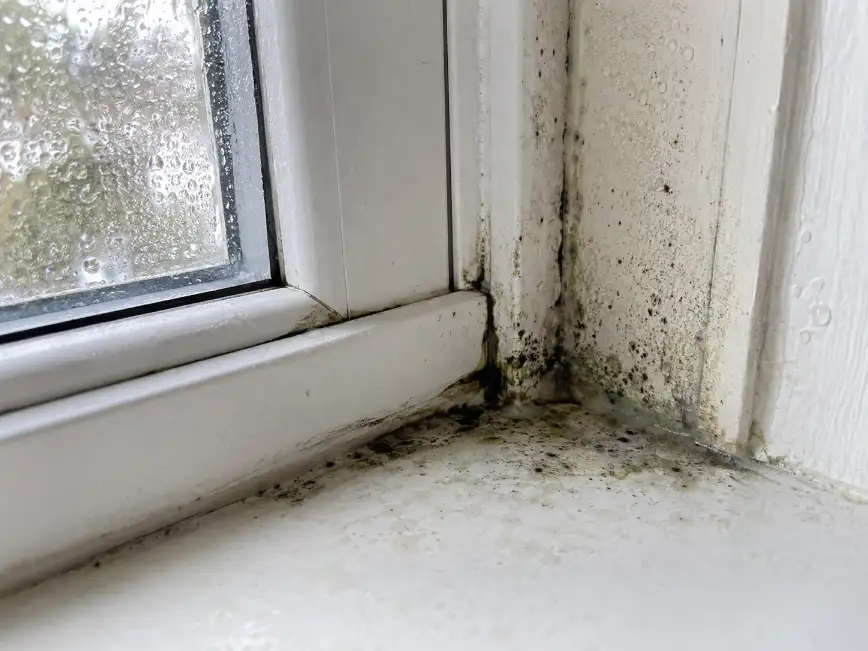
Window Materials Can Stay Damp After the Glass Dries
Condensation may first appear on the glass, but it can run downward and collect on the sash, tracks, sill, trim, drywall, or wall below the window.
Wood joints, damaged caulk, unfinished surfaces, and small gaps may hold moisture longer than the visible glass. Blinds and curtains can also absorb moisture or restrict evaporation.
A homeowner may wipe the glass each morning while dampness continues affecting the surrounding building materials. This is one reason recurring mold around windows should not be treated only as a glass-cleaning problem.
Is the Moisture From Condensation or an Exterior Leak?
Determining whether the moisture originates indoors or outdoors is one of the most important steps. Condensation and exterior leakage may create similar staining, but they normally require different repairs.
| Observation | More Consistent With Condensation | More Consistent With a Leak |
|---|---|---|
| When moisture appears | Cold mornings, very low outdoor temperatures, or after indoor humidity rises | During or after rain, wind-driven storms, snowmelt, or roof runoff |
| Where moisture appears | Interior glass, metal frame, lower sash, or sill | Upper corners, wall surfaces, trim joints, or one side of the opening |
| Pattern | Similar moisture appears on several windows | Damage is concentrated around one window or exterior wall |
| Material damage | Surface spotting, a damp sill, or light finish deterioration | Soft wood, swollen drywall, peeling paint, recurring stains, or wet insulation |
| Indoor humidity | Elevated humidity or heavy indoor moisture production | May occur even when indoor humidity is controlled |
These are general clues, and conditions may overlap. A poorly sealed window can experience both cold-surface condensation and exterior rain intrusion.
Condensation Often Affects Several Windows
If multiple windows become wet during cold weather, indoor humidity and surface temperature are likely contributing factors. Bathrooms, kitchens, laundry rooms, humidifiers, drying clothes indoors, and improperly vented appliances can all add moisture to the air.
Tightly closed homes may retain more indoor humidity during winter. Exhaust ventilation and humidity control become particularly important when exterior temperatures are low and windows remain cold.
Exterior Leaks May Follow Rain, Wind, Ice, or Snowmelt
Exterior water intrusion may come from the window assembly or another building component above or beside it. Possible sources include:
- Deteriorated exterior caulking
- Failed or missing window flashing
- Damaged siding or exterior trim
- Gaps around the window opening
- Roof or gutter problems that direct water toward the wall
- Ice or snowmelt entering through exterior defects
- Cracked masonry or deteriorated joints
- Wind-driven rain entering behind exterior cladding
McMahon Services explains that moisture may enter through windows, siding, roofing, and other exterior openings in its guide to hidden water damage after storms.
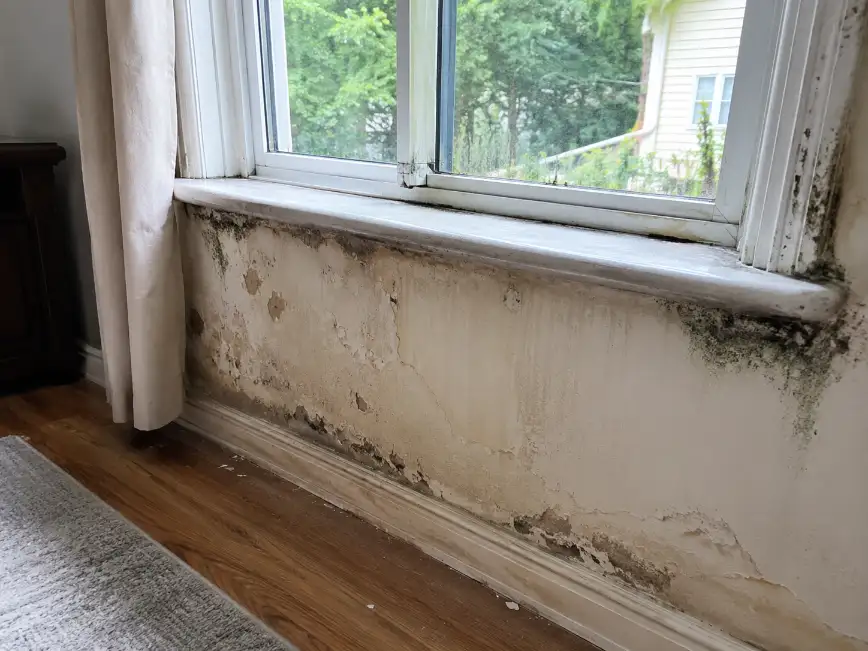
What Causes Recurring Moisture Around Windows?
1. High Indoor Humidity
Cooking, bathing, washing dishes, running a humidifier, drying clothes indoors, and normal household activity release water vapor. When moisture production exceeds ventilation and dehumidification, indoor humidity rises.
The EPA recommends keeping indoor relative humidity below 60 percent when possible, with a general preferred range between 30 and 50 percent. During very cold weather, lower indoor humidity may be necessary to reduce condensation on cold windows.
2. Poor Bathroom or Kitchen Ventilation
Bathroom and kitchen exhaust fans help remove moisture near its source. A fan that is undersized, clogged, rarely used, or vented into an attic rather than outside may not control humidity effectively.
Moisture from showers and cooking can migrate into bedrooms, hallways, and living areas, where it may condense on colder windows.
3. Excessive Humidifier Use
Whole-home and portable humidifiers can improve comfort during dry winter weather, but excessive output may create recurring window condensation.
The appropriate setting may need to change as outdoor temperatures fall. Persistent water on windows is a practical sign that the indoor moisture level may be too high for current conditions.
4. Air Leakage Around the Window
Gaps in the air barrier may allow cold outdoor air to cool the frame, trim, and surrounding wall. These cold spots increase the likelihood of condensation when humid indoor air reaches them.
Air leakage may occur through worn weatherstripping, gaps between the window and framing, loose trim, deteriorated sealant, or incomplete air sealing around the opening.
5. Insulation and Thermal Bridging Problems
Missing or compressed insulation around a window can produce unusually cold interior surfaces. Framing and metal components may also conduct heat more readily than nearby insulated areas.
Cleaning visible mold will not correct a recurring cold spot caused by an insulation or building-envelope problem.
6. Failed Insulated-Glass Seals
Moisture between panes of insulated glass commonly indicates a failed glazing seal. This condition is different from condensation on the room-facing surface.
Moisture between glass panes does not necessarily mean mold is growing inside the wall, but it may reduce the clarity and insulating performance of the glass unit. The window should be evaluated separately from mold or water damage affecting the frame and surrounding materials.
7. Exterior Caulk or Flashing Failure
Exterior caulk is only one part of a properly water-managed window installation. Failed flashing or drainage details can allow water to move behind the window and wall finishes without creating an obvious opening.
Recurring staining after rain, wet upper corners, or softened building materials should be investigated rather than repeatedly recaulked without identifying the complete water path.
8. Restricted Airflow
Heavy curtains, tightly closed blinds, furniture, storage boxes, and decorative items can reduce warm air circulation around windows. The glass and trim then remain colder, while moisture may stay trapped behind the covering.
Opening blinds periodically and maintaining space around the window can help surfaces warm and dry. However, improved airflow will not correct exterior water intrusion.
What Warning Signs Should Homeowners Inspect?
Possible signs of mold, condensation, or hidden water damage include:
- Black, green, brown, gray, or white spotting on the sill or frame
- Water droplets or frost on the interior glass
- A musty odor that becomes stronger near the window
- Peeling, bubbling, or discolored paint
- Swollen, cracked, soft, or deteriorated wood trim
- Soft drywall or plaster around the opening
- Brown or yellow stains beneath the sill
- Deteriorated caulk or visible gaps around the frame
- Wet carpet or flooring below the window
- Condensation trapped behind curtains or blinds
- Staining that becomes worse after rain
- Growth that returns soon after cleaning
Mold Color Does Not Identify the Species
Dark growth around a window is often described as black mold, but appearance alone cannot identify a mold species or determine the extent of the problem.
The more useful restoration questions are:
- Where is the moisture coming from?
- How far has the moisture traveled?
- Which materials are affected?
- Can the materials be cleaned and dried?
- Does concealed damage require controlled access?
Recurring Growth Indicates an Unresolved Moisture Condition
If mold returns after cleaning, the surface is likely continuing to get wet. The cause may be condensation, a concealed leak, inadequate ventilation, poor insulation, air leakage, or moisture trapped inside porous materials.
Repeatedly applying cleaner or repainting the area will not provide a lasting solution when the moisture source remains active.
Which Materials Around a Window May Be Affected?
| Material | Possible Damage | Restoration Consideration |
|---|---|---|
| Glass and metal | Condensation, surface residue, corrosion, and damaged finishes | Nonporous surfaces may often be cleaned when damage is limited and the moisture source is corrected |
| Painted wood trim | Staining, peeling finish, swelling, softening, or mold growth | Cleaning may be possible when the wood remains sound; deteriorated sections may require replacement |
| Drywall | Staining, softened gypsum, damaged paper facing, concealed mold, or crumbling | Porous or deteriorated sections may require controlled removal |
| Insulation | Reduced performance, trapped moisture, odor, or contamination | Wet or mold-affected insulation may need removal so the wall cavity can be inspected and dried |
| Caulk and sealant | Cracking, separation, staining, and surface growth | Failed material may require removal and replacement after surrounding materials are cleaned and dried |
| Curtains and blinds | Absorbed moisture, odor, staining, and surface growth | Cleaning or replacement depends on the material and extent of contamination |
| Framing and sheathing | Hidden moisture, mold growth, staining, or wood deterioration | Controlled wall access may be required when exterior water entered the assembly |
What Should You Do When You Find Mold Around a Window?
-
Photograph the condition.
Document visible mold, condensation, staining, damaged paint, trim, and nearby flooring before cleaning or removing materials.
-
Dry visible condensation promptly.
Use a clean absorbent material without aggressively disturbing widespread growth. Do not allow water to remain pooled on wood, drywall, or flooring.
-
Measure indoor humidity.
A hygrometer can help determine whether elevated indoor humidity is contributing to condensation.
-
Observe when the moisture appears.
Note whether it follows cold weather, showers, cooking, rain, wind, snowmelt, or operation of a humidifier.
-
Improve ventilation where appropriate.
Use properly vented kitchen and bathroom exhaust fans and allow warm air to circulate around the window.
-
Inspect visible exterior conditions from a safe location.
Look for damaged caulk, siding, trim, gutters, roofing, or other defects. Do not climb onto a roof or use an unsafe ladder.
-
Check nearby materials.
Look for soft drywall, swollen trim, damp carpet, damaged flooring, stained walls, and moisture below or beside the window.
-
Arrange professional evaluation when damage is recurring or concealed.
A restoration and mold remediation professional can identify the affected boundary and determine whether materials require cleaning, drying, controlled removal, or repair.
Safety Warning: Avoid disturbing extensive or concealed mold growth. People with asthma, allergies, immune suppression, chronic lung conditions, or other health concerns should not participate in mold cleanup without appropriate medical and professional guidance.
What Mistakes Should You Avoid?
- Do not paint over visible mold or water stains. The moisture source and damaged materials must be addressed first.
- Do not rely only on bleach. Applying a chemical to the surface does not dry wet drywall, insulation, wood, or a concealed wall cavity.
- Do not caulk over wet or deteriorated materials. New caulk may conceal rather than correct an active leak.
- Do not assume every wet window has failed. Condensation may come from indoor humidity and cold surfaces rather than rain intrusion.
- Do not assume every problem is condensation. Recurring stains after storms or softened materials may indicate an exterior leak.
- Do not close heavy curtains over a wet window. Restricted airflow can slow drying.
- Do not sand or aggressively scrub mold-affected wood. Disturbance may spread contaminated dust.
- Do not replace trim before checking the wall cavity. Hidden moisture may remain behind the visible materials.
Can Mold-Affected Window Materials Be Cleaned?
Some limited surface growth on sound, nonporous, or semi-porous materials may be cleanable after the moisture source is corrected. Other materials may require removal when mold or water damage has penetrated deeply.
Cleaning May Be More Appropriate When:
- The affected area is limited and fully visible
- The material remains solid and structurally sound
- The growth is primarily on a cleanable surface
- There is no continuing leak or condensation problem
- The surrounding wall and insulation are dry
- The material can tolerate cleaning without being damaged
Removal May Be More Appropriate When:
- Drywall is soft, swollen, crumbling, or mold-affected through the paper facing
- Wood trim is rotted, deeply stained, warped, or structurally deteriorated
- Insulation is wet or contaminated
- Mold is growing inside the wall cavity
- The window leak remained active for an extended period
- A persistent musty odor remains after appropriate cleaning
- Materials prevent access to concealed moisture
The EPA advises that mold-affected absorbent materials may need replacement because growth can enter pores and crevices. The water or humidity source must also be corrected to prevent recurrence.
McMahon Services provides professional mold removal and remediation services for homes and businesses with visible, recurring, or concealed mold damage.
How Does Professional Window Mold Remediation Work?
1. Moisture-Source Assessment
The inspection begins by determining whether the moisture is caused by indoor condensation, exterior leakage, plumbing, roofing, siding, flashing, or another source.
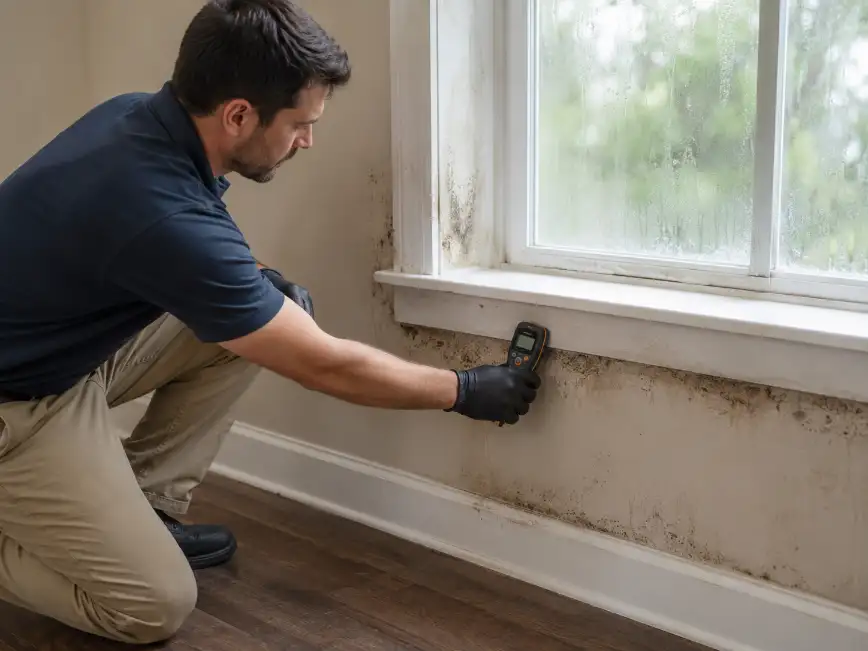
2. Moisture Mapping
Technicians may evaluate the sill, trim, drywall, wall cavity, insulation, flooring, and nearby materials. Moisture readings can help identify damp areas that are not visible from the surface.
3. Work-Area Protection
When mold-affected materials must be disturbed, containment and air-management procedures may be used to reduce the spread of dust and spores into surrounding rooms.
4. Controlled Material Removal
Damaged trim, drywall, insulation, caulk, or other materials may be removed when they cannot be safely cleaned, dried, or retained.
5. Cleaning and HEPA Filtration
Remaining materials may be cleaned using methods selected for the surface and project conditions. HEPA-filtered equipment may be used as part of the remediation process.
6. Structural Drying
Wet framing, sheathing, drywall edges, flooring, or other building materials must be dried before the opening is closed and repaired.
When window mold is connected to a larger water loss, McMahon Services also provides water damage cleanup and structural drying services.
7. Moisture-Source Repair
The condensation, air-sealing, exterior drainage, roofing, siding, flashing, caulking, insulation, or window problem must be corrected. Mold remediation without source repair may allow the problem to return.
McMahon Services provides storm damage restoration, roofing, and siding services when exterior building damage contributes to water intrusion.
8. Reconstruction
After remediation, drying, and source correction are complete, removed drywall, insulation, trim, paint, flooring, and other finishes can be restored.
McMahon Services can coordinate cleanup and rebuilding after property damage when the project requires both mold remediation and permanent construction repairs.
How Can You Help Prevent Mold From Returning Around Windows?
| Action | Why It Helps |
|---|---|
| Monitor indoor relative humidity | Helps identify when excess indoor moisture may be contributing to condensation |
| Adjust humidifier settings during cold weather | Reduces moisture collecting on cold glass, frames, and exterior walls |
| Use kitchen and bathroom exhaust fans | Removes moisture near major indoor sources |
| Maintain airflow around windows | Helps surfaces warm and allows condensation to dry |
| Dry condensation promptly | Limits how long sills, trim, caulk, and walls remain wet |
| Maintain exterior caulk and drainage | Reduces the likelihood of rain entering through exterior gaps |
| Repair roof, siding, gutter, and flashing damage | Prevents water from reaching the window opening from nearby building components |
| Address insulation and air leakage | Reduces cold interior surfaces where condensation may form |
Professional Tip: A humidifier setting that works during mild winter weather may produce excessive condensation during severe cold. Use the condition of the windows and an indoor humidity meter as practical indicators, and lower humidity when water repeatedly collects on the glass or frames.
How Long Does Window Mold Remediation Take?
The timeline depends on the moisture source and extent of material damage. Limited surface growth caused by temporary condensation may require relatively little work after humidity is controlled.
A window leak affecting drywall, insulation, framing, and flooring may require investigation, controlled material removal, structural drying, exterior repairs, mold remediation, and reconstruction.
| Timeline Factor | Why It Matters |
|---|---|
| Moisture source | Humidity control may be faster than locating and repairing a concealed exterior leak. |
| Extent of concealed damage | Wet insulation, framing, drywall, or flooring increases the restoration scope. |
| Material condition | Sound materials may be cleaned, while deteriorated materials may require replacement. |
| Drying progress | Repairs should wait until affected materials reach an appropriate dry condition. |
| Exterior repair requirements | Roofing, siding, flashing, masonry, or window work may add repair stages. |
| Reconstruction scope | Replacing insulation, drywall, trim, paint, or flooring extends the project. |
A reliable completion date should be based on source correction, remediation, drying verification, and repair requirements rather than a predetermined number of days.
What Should You Document for an Insurance Claim?
Coverage depends on the policy and cause of damage. A sudden storm-created opening may be treated differently from long-term condensation, deteriorated caulk, or maintenance-related leakage.
When conditions are safe, document:
- Visible mold, condensation, staining, and material deterioration
- The date and weather conditions when moisture appears
- Damage after rain, snowmelt, wind, or severe cold
- Interior and safely accessible exterior conditions
- Damaged drywall, trim, insulation, flooring, and window coverings
- Indoor humidity readings and professional moisture measurements
- Inspection, drying, and mold remediation reports
- Roofing, siding, window, restoration, and reconstruction estimates
- Photographs taken before, during, and after material removal
Do not discard damaged materials before documenting them unless immediate removal is necessary for safety or contamination control. Contact the insurance carrier to ask what records and inspections it requires.
Why Is Window Mold Common During Northern Illinois Winters?
Northern Illinois homes experience long periods when outdoor temperatures are substantially colder than indoor temperatures. Window glass, frames, exterior walls, and poorly insulated openings may become cold enough for indoor water vapor to condense.
Several winter conditions may increase the risk:
- Very cold glass and window frames
- Closed windows and reduced natural ventilation
- Whole-home or portable humidifier use
- Long showers and indoor cooking
- Drying clothing indoors
- Heavy curtains and closed blinds
- Air leakage or missing insulation around window openings
- Snow, ice, and wind-driven moisture affecting exterior components
Spring and summer can create different risks. Heavy rain, thunderstorms, damaged siding, roof problems, and clogged drainage systems may allow water to enter around windows and remain concealed inside walls.
For property owners in Hainesville, Lake County, Northern Illinois, Southern Wisconsin, and surrounding communities, the important distinction is whether the problem is primarily indoor condensation, exterior water intrusion, or a combination of both.
Get Professional Help With Mold Around Windows
Recurring mold around windows should not be treated only as a cosmetic issue. Moisture may be affecting the frame, trim, drywall, insulation, flooring, sheathing, or concealed wall components.
McMahon Services & Construction Corp can help identify the affected area, address water and moisture damage, remove materials that cannot be restored, perform mold remediation, and coordinate repairs and reconstruction.
McMahon Services provides professional mold removal and remediation and water damage restoration services for homes and businesses throughout Hainesville, Lake County, Northern Illinois, Southern Wisconsin, and surrounding service areas.
Call McMahon Services at (847) 566-4568 for 24/7 assistance with recurring window moisture, hidden water damage, and suspected mold.
Frequently Asked Questions About Mold Around Windows
Why does mold grow around my windows every winter?
Warm, humid indoor air can condense on cold window glass, frames, and trim during winter. If the moisture repeatedly wets dust, wood, drywall, caulk, or window coverings, mold may grow. Indoor humidity, insulation, air leakage, and restricted airflow can all contribute.
Is mold around a window always caused by condensation?
No. Rain intrusion, failed flashing, damaged siding, deteriorated caulk, roof drainage problems, and gaps around the window opening can also introduce moisture. Staining that worsens after storms or soft building materials may indicate a leak.
Can I clean window mold with bleach?
Applying bleach does not control condensation, repair an exterior leak, dry a wall cavity, or restore deteriorated porous materials. Limited surface growth may be cleanable with an appropriate method, but recurring or concealed damage requires moisture-source correction and may require professional remediation.
What indoor humidity level helps prevent window condensation?
The EPA generally recommends keeping indoor relative humidity below 60 percent, ideally between 30 and 50 percent. During very cold weather, a lower level may be necessary to reduce condensation on cold glass and window frames.
Does black mold around a window mean it is toxic mold?
No. Mold color alone does not identify its species or determine its potential effects. The priority is identifying and correcting the moisture source and safely addressing the affected materials.
Should moldy window trim be replaced?
Not always. Sound trim with limited surface growth may be cleanable after the moisture source is corrected. Replacement is more likely when the wood is soft, rotted, deeply stained, warped, or affected throughout the material.
Can mold grow inside the wall around a window?
Yes. Water from failed flashing, exterior gaps, condensation, or another leak can wet insulation, drywall, sheathing, and framing. A musty odor, recurring stains, soft drywall, or growth that returns after cleaning may justify professional inspection.
Who should I call when mold keeps returning around a window?
Contact a professional mold remediation and water damage restoration company when the growth is recurring, extensive, concealed, or associated with damaged building materials. Roofing, siding, window, insulation, or building-envelope repairs may also be needed to correct the source.




0 Comments