
What Happens When Water Gets Behind Kitchen Cabinets?
Water damage behind kitchen cabinets can affect far more than the visible cabinet surface. Water from a leaking sink, dishwasher, refrigerator supply line, drain connection, garbage disposal, or concealed pipe can travel beneath cabinet bases, behind toe-kicks, into drywall, under finished flooring, and across the subfloor before the damage becomes obvious.
The cabinet face and countertop may appear dry while the cabinet back, particleboard base, wall cavity, insulation, flooring adhesive, or subfloor remains wet. Fixed cabinets restrict airflow and hide affected materials, allowing moisture to remain trapped long enough to cause swelling, separation, staining, musty odors, deterioration, and mold growth.
Prompt water extraction and professional moisture inspection are important. The leak must be repaired, and the complete moisture boundary should be identified before cabinets are refinished, flooring is replaced, or damaged walls are closed. In some cases, toe-kicks, trim, flooring, or individual cabinet sections must be removed to reach wet materials properly.
Quick Answer
Water behind kitchen cabinets can soak the cabinet base, drywall, insulation, flooring, and subfloor without remaining visible. Warning signs include swollen cabinet panels, loose toe-kicks, peeling finishes, musty odors, stained drywall, warped flooring, and recurring moisture near sinks or appliances. Stop the leak, use electrical caution, document the damage, and arrange professional moisture inspection and structural drying before permanent repairs begin.
Key Takeaways
- A dry countertop or cabinet face does not prove that concealed materials are dry.
- Water can move beneath several connected cabinets and into adjoining rooms.
- Particleboard, medium-density fiberboard, plywood, drywall, insulation, flooring, and subflooring respond differently to water exposure.
- Swollen composite cabinet materials may not return to their original strength or dimensions after drying.
- Toe-kicks, flooring, trim, or cabinet sections may need controlled removal to reach hidden moisture.
- Water from drains, dishwasher discharge, sewage, or an unknown source requires additional contamination precautions.
- New cabinets, flooring, drywall, or paint should not be installed over damp materials.
- Recurring odors, staining, or visible growth may indicate mold behind kitchen cabinets or inside the wall.
Table of Contents
- How water gets behind kitchen cabinets
- Where concealed water may travel
- Warning signs of hidden cabinet water damage
- How cabinet materials respond to water
- What to do after discovering the leak
- Mistakes to avoid
- When cabinets may need removal
- Can wet kitchen cabinets be saved?
- How professional restoration works
- How long drying may take
- Can mold grow behind kitchen cabinets?
- Electrical and appliance concerns
- Insurance documentation considerations
- Northern Illinois and Southern Wisconsin risks
- Frequently asked questions
How Does Water Get Behind Kitchen Cabinets?
Kitchen cabinets commonly conceal plumbing lines, drainpipes, appliance connections, electrical outlets, and openings through walls or floors. A leak in any of these areas can release water beneath or behind the cabinet before it appears in the room.
Common Sources of Kitchen Cabinet Water Damage
- Leaking sink supply lines or shutoff valves
- Loose, cracked, or damaged drain connections
- Garbage disposal leaks
- Dishwasher supply-line or drain-hose failures
- Refrigerator and ice-maker supply-line leaks
- Dishwasher overflows
- Cracked sink basins or failed sink seals
- Water entering through damaged countertop seams
- Burst or frozen pipes inside the wall
- Drain or sewage backups
- Water entering from a room or floor above
- Exterior wall, window, or roof leaks near the kitchen
Some failures release a large amount of water immediately. Others create a slow drip that remains concealed for days or weeks. A refrigerator supply-line leak, for example, may run beneath the appliance and adjoining cabinets before reaching a visible flooring edge.
A slow sink-drain leak may wet the cabinet floor first, then spread into the toe-kick cavity, finished flooring, drywall, and subfloor. By the time swelling, staining, or odor becomes noticeable, the concealed affected area may be larger than expected.
Sink Cabinets Are Particularly Vulnerable
The cabinet beneath a kitchen sink contains several possible leak points, including faucet supply lines, shutoff valves, drain connections, garbage disposal components, dishwasher drains, and plumbing penetrations.
Stored cleaning products, trash containers, paper goods, and household items can conceal a small leak. These contents may also absorb water and hold moisture against the cabinet base after the plumbing problem is repaired.
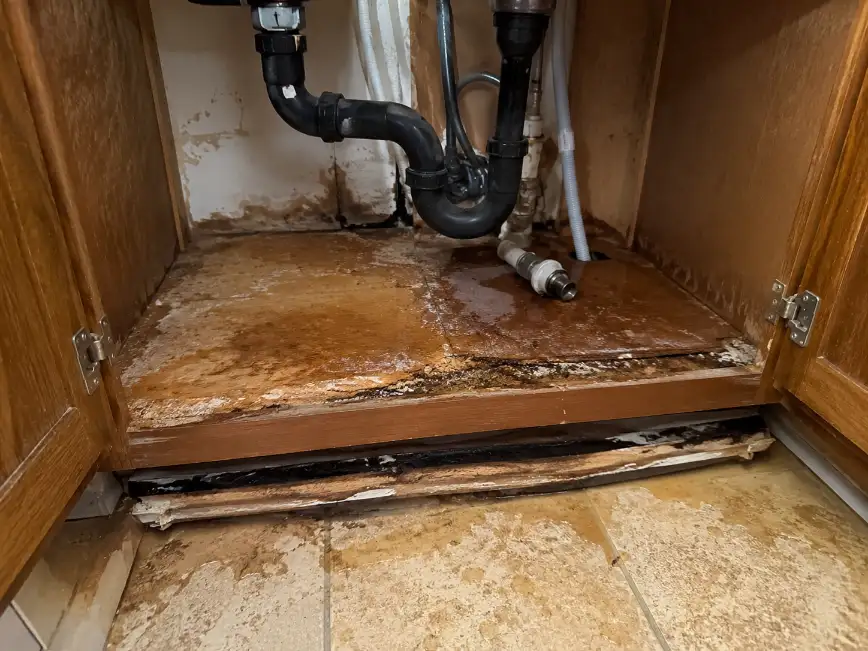
Checking the sink cabinet periodically for moisture, corrosion, staining, soft materials, and musty odors can help identify a leak before it spreads farther.
Water Can Enter Wall and Floor Openings
Cabinet backs and floors often contain openings for water lines, drainpipes, appliance cords, and electrical connections. Water can follow these penetrations into the wall cavity or floor assembly.
Once inside a concealed cavity, moisture may affect drywall paper, insulation, wood framing, electrical components, flooring, and the room on the opposite side of the wall.
Where Can Water Travel After It Gets Behind a Cabinet?
Water rarely remains directly beneath the original leak. It follows gravity, seams, gaps, floor transitions, wall cavities, and low areas in the subfloor.
Concealed water may affect:
- The cabinet floor, back, sides, face frame, and fasteners
- Toe-kicks and decorative trim
- Drywall behind and beside the cabinets
- Wall insulation and structural framing
- Hardwood, laminate, vinyl, or tile flooring
- Flooring underlayment and adhesive
- Plywood or oriented strand board subflooring
- Cabinets located beside the original leak
- Closets, hallways, or rooms on the opposite side of the wall
- The ceiling and walls on the level below
- Electrical outlets, wiring, and appliance connections
Water May Travel Under an Entire Cabinet Row
Base cabinets are commonly connected and installed along a continuous wall. Water entering beneath one cabinet can move under neighboring sections through the toe-kick cavity or along the flooring system.
The visible damage may appear beneath the sink while moisture has already reached the dishwasher opening, corner cabinet, adjacent pantry, refrigerator space, or a nearby flooring transition.
Flooring Installation Changes the Water Path
Some kitchen floors extend beneath the cabinets. Other floors stop at the cabinet toe-kick. The installation method affects where water travels and how easily the concealed area can be inspected.
Moisture can become trapped beneath vinyl, laminate, tile, engineered wood, or hardwood. The finished floor may look normal while the adhesive, underlayment, or subfloor remains wet.
McMahon Services explains how concealed moisture can remain behind walls, under flooring, and inside structural spaces in its guide to hidden water damage after storms.
Upper-Level Kitchen Leaks Can Affect the Ceiling Below
In a multilevel property, water from a kitchen leak may penetrate the subfloor and enter the ceiling below. Warning signs may include stains, bubbling paint, softened drywall, dripping light fixtures, or a sagging ceiling.
Do not stand beneath a bulging ceiling or touch a wet light fixture. Water near electrical equipment requires immediate caution and professional evaluation.
What Are the Warning Signs of Water Damage Behind Kitchen Cabinets?
Hidden cabinet water damage may not create an obvious puddle. Homeowners should watch for changes in the cabinets, walls, flooring, appliances, and indoor odor.
Common Warning Signs Include:
- A cabinet floor that feels swollen, soft, uneven, or spongy
- Particleboard or fiberboard edges that appear raised or crumbly
- Loose, warped, or separating toe-kicks
- Peeling laminate, veneer, paint, or cabinet finish
- Dark staining inside or beneath the cabinet
- A musty or earthy odor near the sink or dishwasher
- Water appearing between flooring seams
- Hardwood that cups, crowns, or buckles
- Laminate flooring with swollen joints or raised edges
- Loose vinyl or tile near the cabinet base
- Stained, bubbling, or softened drywall beside the cabinets
- Corrosion around shutoff valves and plumbing connections
- Recurring water beneath a refrigerator or dishwasher
- Visible mold along the cabinet base or wall-floor joint
- An unexplained increase in indoor humidity
A Musty Odor Should Be Investigated
A persistent musty odor may indicate wet wood, drywall, flooring, insulation, stored contents, or mold growth inside a concealed area.
Air fresheners and surface cleaners may temporarily cover the smell, but they do not repair the leak or dry the materials producing the odor.
The odor may become stronger when cabinet doors remain closed, indoor humidity rises, or the kitchen has not been used for several hours.
Swelling May Indicate Internal Material Damage
Particleboard and medium-density fiberboard can absorb water through unfinished edges, seams, fastener holes, and damaged laminate. The material may expand and lose strength as moisture penetrates its internal fibers.
Once a composite panel has swollen, crumbled, or separated, drying may stop additional deterioration but may not restore its original strength, dimensions, or appearance.
How Do Different Kitchen Cabinet Materials Respond to Water?
| Cabinet Material | Possible Water-Damage Response | Restoration Consideration |
|---|---|---|
| Solid wood | Swelling, warping, splitting, staining, finish damage, and mold growth | Structurally sound wood may sometimes be dried, cleaned, repaired, and refinished. |
| Plywood | Swelling, edge damage, staining, veneer separation, and delamination | Limited wetting may be restorable, while separated layers may require replacement. |
| Particleboard | Rapid swelling, crumbling edges, fastener failure, and permanent distortion | Heavily swollen or weakened sections commonly require replacement. |
| Medium-density fiberboard | Expansion, softened edges, finish separation, and loss of shape | The degree of swelling and remaining structural integrity determine whether replacement is necessary. |
| Laminate-covered panels | Moisture beneath laminate, bubbling, peeling, and swollen substrate | The exterior laminate may conceal damage inside the panel. |
| Wood veneer | Lifting, bubbling, staining, adhesive failure, and separation | Repair depends on the substrate condition and whether the veneer can be securely reattached. |
| Metal cabinets | Corrosion, damaged coatings, staining, and water trapped at seams | The cabinet may be cleanable when corrosion and coating damage are limited. |
The cabinet material is only one consideration. The source of water, duration of exposure, contamination level, amount of saturation, finish condition, and condition of the wall and flooring behind the cabinet also affect the restoration decision.
What Should You Do After Finding Water Behind Kitchen Cabinets?
-
Stop the water source when it is safe.
Close the appropriate supply valve or stop using the affected appliance. Contact a plumber or appliance technician when the source cannot be safely isolated.
-
Use electrical caution.
Do not reach into standing water near a garbage disposal, dishwasher connection, refrigerator outlet, appliance cord, or electrical receptacle.
-
Determine whether the water may be contaminated.
Water from a clean supply line differs from water released by a drain, dishwasher discharge, sewage backup, or unknown source. Avoid direct contact when contamination is possible.
-
Remove dry contents from unaffected cabinet areas.
Relocate cookware, dishes, food, paper products, and cleaning supplies when they can be moved without entering an unsafe wet area.
-
Document the damage.
Photograph the leak source, standing water, cabinet swelling, flooring damage, wall stains, affected contents, and nearby appliances before major cleanup begins.
-
Remove accessible standing water.
A significant leak may require professional water extraction before concealed materials can be evaluated and dried.
-
Inspect adjoining areas.
Check neighboring cabinets, the opposite side of the wall, adjacent rooms, the basement, crawl space, and ceiling below.
-
Arrange a professional moisture evaluation.
Technicians may need to inspect the cabinet base, toe-kick cavity, drywall, insulation, flooring, and subfloor to determine the complete affected boundary.
Safety Warning: Do not use electrical appliances, extension cords, household fans, or wet vacuums in standing water or near wet electrical components. Water from drains, sewage, or unknown sources also requires additional contamination precautions.
What Mistakes Should You Avoid?
- Do not assume the leak affected only one cabinet. Water may have traveled beneath adjoining cabinets and flooring.
- Do not close the cabinet and wait for natural drying. Restricted airflow can keep concealed materials wet.
- Do not repaint or cover swollen cabinet material. Cosmetic repairs do not restore weakened composite wood.
- Do not install a new toe-kick over a damp cavity. This may conceal moisture, odor, and mold growth.
- Do not install new flooring over a wet subfloor. Trapped moisture may cause renewed swelling, adhesive failure, odor, and mold.
- Do not assume bleach reaches behind the cabinets. Surface chemicals do not dry wall cavities, insulation, or subflooring.
- Do not aggressively disturb visible mold. Cutting, sanding, or removing mold-affected materials may spread contaminated dust.
- Do not discard damaged parts before documenting them. Photographs and retained samples may help identify cabinet construction, finish, and repair requirements.
- Do not reconnect a leaking appliance before surrounding materials are inspected. Repairing the source and restoring the building are separate steps.
Do Kitchen Cabinets Need to Be Removed After Water Damage?
Not always. Limited clean-water exposure may sometimes be addressed without removing an entire cabinet run when the affected materials are accessible and can be dried successfully.
However, toe-kicks, trim, cabinet bottoms, countertop sections, or individual cabinet boxes may need controlled removal when they conceal wet drywall, insulation, flooring, plumbing, or subflooring.
Cabinet Removal May Be Necessary When:
- Water is trapped beneath the cabinet base
- The toe-kick cavity cannot be accessed for extraction and drying
- Drywall or insulation behind the cabinet remains wet
- The subfloor is saturated, swollen, soft, or mold-affected
- Particleboard or fiberboard has expanded and lost strength
- Veneer, laminate, or cabinet layers have separated
- Sewage or contaminated water affected porous materials
- Visible mold is present behind the cabinet
- The cabinet prevents plumbing or structural repairs
- Odor continues after accessible surfaces have been cleaned
Toe-Kick Removal May Provide Limited Access
A removable toe-kick may provide access to inspect or dry the space beneath a cabinet without removing the entire cabinet box.
This approach is only appropriate when the affected boundary can be reached and the cabinet remains structurally sound. Toe-kick access may not be sufficient when water has entered the wall, insulation, subfloor, or fixed cabinet materials.
Countertops Can Complicate Cabinet Removal
Base cabinets often support countertops, sinks, plumbing fixtures, backsplashes, and built-in appliances. Removing a damaged cabinet may therefore require coordination among plumbing, countertop, appliance, restoration, and reconstruction professionals.
Controlled disassembly may help preserve reusable doors, drawer fronts, hardware, countertop sections, and trim when practical.
Can Wet Kitchen Cabinets Be Saved?
Some water-damaged cabinets can be dried and restored. Others require partial or complete replacement.
Cabinets May Be More Likely to Be Saved When:
- The water came from a clean supply source
- The leak was discovered and repaired promptly
- The cabinet remains square, solid, and securely attached
- There is no significant swelling, crumbling, or delamination
- The cabinet and concealed materials can be accessed and dried
- There is no persistent mold or musty odor
- The finish can tolerate the required cleaning process
- Moisture readings show consistent drying progress
Replacement May Be More Likely When:
- Particleboard or fiberboard is swollen, soft, or breaking apart
- Plywood layers or veneer have separated
- The cabinet box has warped or lost structural strength
- Fasteners no longer hold securely
- Mold is growing inside porous cabinet materials
- Sewage or contaminated water affected the cabinet
- Persistent odor remains after appropriate cleaning
- Removal is necessary to repair damaged walls, plumbing, flooring, or subflooring
Partial Cabinet Repair May Be Possible
Damage may be limited to a removable cabinet floor, toe-kick, side panel, trim piece, or individual cabinet box. These parts may sometimes be replaced while undamaged doors, drawer fronts, hardware, and surrounding cabinets are retained.
Matching the cabinet finish, profile, material, color, and age can affect whether a partial repair provides an acceptable result.
McMahon Services provides cleanup and rebuilding after property damage when cabinet removal must be followed by drywall, flooring, trim, painting, or kitchen reconstruction.
How Is Water Damage Behind Kitchen Cabinets Professionally Restored?
Professional restoration focuses on stopping the source, identifying the complete moisture boundary, evaluating contamination, drying restorable materials, removing damaged components, and planning permanent repairs.
1. Safety and Water-Source Evaluation
The restoration team checks for electrical hazards, contaminated water, damaged plumbing, unstable cabinet materials, and affected appliances. The water source must be stopped before effective restoration can continue.
2. Water-Source Repair
A plumber, appliance technician, or another qualified professional may repair a supply line, shutoff valve, dishwasher hose, drain connection, disposal, refrigerator line, or concealed pipe.
McMahon Services also provides emergency plumbing services when urgent repairs are required to stop the water source.
3. Damage Documentation
Technicians photograph the leak source, cabinet damage, flooring, walls, appliances, and affected contents. Measurements and project notes may be recorded before removal changes the visible condition.
4. Water Extraction
Standing water is removed from the cabinet, flooring, appliance openings, toe-kick cavity, basement, crawl space, or lower-level ceiling area.
Removing liquid water promptly reduces the amount available to continue soaking into porous materials.
5. Moisture Mapping
The cabinet base, drywall, flooring, subfloor, insulation, adjoining cabinets, and nearby rooms are evaluated to determine how far the water traveled.
Moisture meters and other inspection methods help identify damp materials that appear dry from the surface.
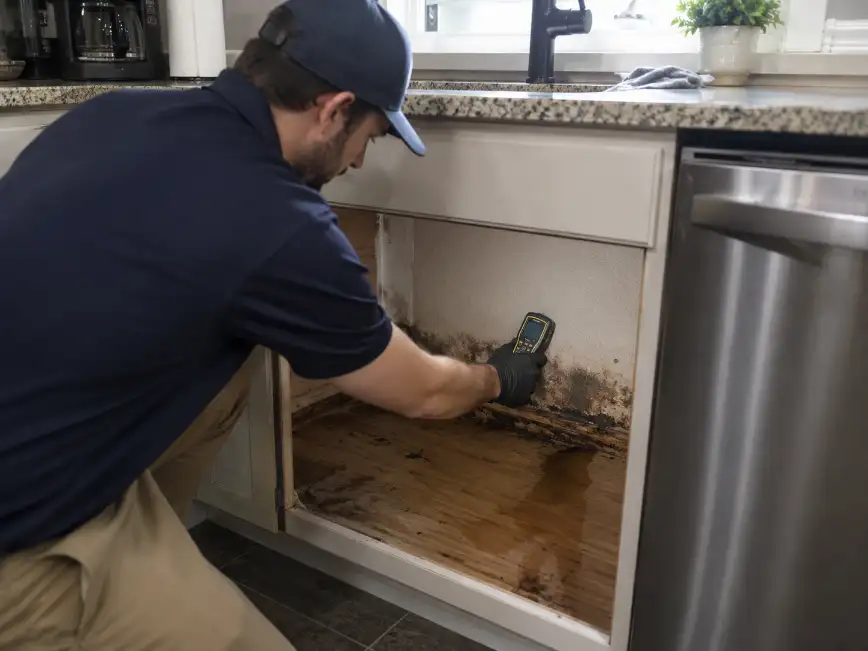
6. Creating Drying Access
Cabinet contents, toe-kicks, trim, baseboards, flooring, drywall, or cabinet sections may be removed when they prevent inspection or effective drying.
Controlled access allows technicians to reach wet wall cavities, insulation, flooring adhesive, underlayment, and subflooring without removing more material than necessary.
7. Material Evaluation
Cabinets, drywall, insulation, flooring, subflooring, trim, and contents are evaluated to determine what can be cleaned and dried and what requires removal.
The source and condition of the water are important. McMahon Services explains clean, gray, and black water considerations in its guide to the categories and classes of water damage.
8. Controlled Structural Drying
Professional air movement, dehumidification, temperature management, and moisture monitoring may be used to dry materials that can be retained.
Equipment should be positioned according to the cabinet layout, water source, electrical conditions, material construction, contamination concerns, and extent of concealed moisture.
9. Cleaning and Contamination Control
Affected surfaces are cleaned according to the water condition and materials involved. Contaminated porous materials may require controlled removal rather than ordinary surface cleaning.
10. Moisture Monitoring
Moisture readings and indoor environmental conditions are checked during drying. Equipment may be repositioned or adjusted as materials respond.
Drying equipment should not be removed merely because the cabinet face or visible flooring looks dry.
11. Mold Remediation When Necessary
Visible or concealed mold may require containment, controlled material removal, HEPA filtration, surface cleaning, and additional moisture correction.
McMahon Services provides professional mold removal and remediation services when kitchen water damage results in mold behind cabinets, walls, flooring, or appliances.
12. Reconstruction
After the affected area is clean, dry, and ready for repairs, contractors can replace damaged drywall, insulation, flooring, subflooring, cabinets, trim, paint, and finishes.
The difference between emergency drying, restoration, and permanent repairs is explained in McMahon Services’ guide to water mitigation, restoration, and reconstruction.
How Long Does Water Behind Kitchen Cabinets Take to Dry?
There is no universal drying period. A small supply-line leak discovered quickly may require limited extraction and drying. A slow leak affecting several cabinets, a wall cavity, flooring, and subflooring may require controlled removal, extended monitoring, mold remediation, and reconstruction.
| Drying Factor | Why It Matters |
|---|---|
| Length of exposure | A slow leak may saturate cabinets, walls, flooring, and subflooring before discovery. |
| Water source | Drain water, sewage, and contaminated water may require removal of porous materials. |
| Cabinet construction | Solid wood, plywood, particleboard, and fiberboard absorb and release moisture differently. |
| Access to wet areas | Toe-kicks, flooring, countertops, or cabinet sections may block airflow and inspection. |
| Wall and insulation damage | Wet drywall and insulation can continue releasing moisture into the cabinet area. |
| Flooring and subflooring | Moisture trapped beneath finished flooring may require controlled access. |
| Indoor drying conditions | Temperature, humidity, airflow, and dehumidification affect drying progress. |
Drying decisions should be based on repeated moisture measurements and material condition rather than a predetermined number of days.
The EPA recommends drying water-damaged areas and materials within 24 to 48 hours whenever possible to reduce the likelihood of mold growth. This does not mean every concealed cabinet assembly will be completely dry within that period. It means extraction and moisture control should begin promptly.
Review the EPA guide to mold and moisture control.
Can Mold Grow Behind Kitchen Cabinets?
Yes. Mold can grow behind kitchen cabinets when drywall, wood, particleboard, insulation, dust, flooring, or subflooring remains damp.
Fixed cabinets can create favorable conditions for hidden growth because they restrict visibility and airflow. A leak may continue unnoticed while enclosed materials dry slowly.
Possible Signs of Mold Behind Cabinets Include:
- A persistent musty odor inside or near the cabinet
- Dark, green, gray, white, or brown growth along seams
- Recurring staining after the visible surface is cleaned
- Soft or deteriorated drywall behind the cabinet
- Swollen cabinet bases and toe-kicks
- Visible growth beneath the sink or beside an appliance
- Odor becoming stronger when cabinet doors are opened
- Mold or staining on the opposite side of the wall
- Moisture remaining beneath flooring or inside the wall cavity
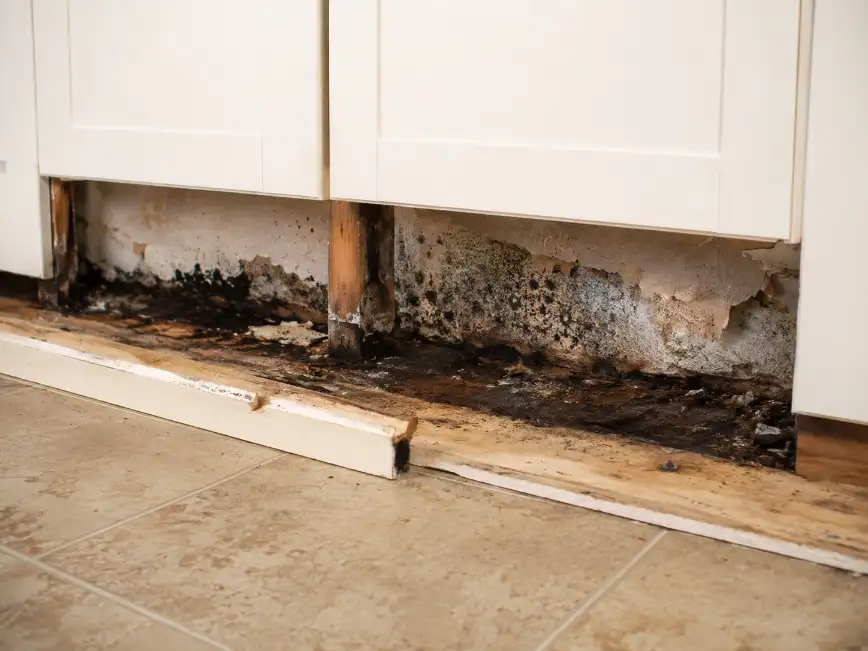
Mold color alone does not identify the species or determine the complete affected boundary. The priority is locating and correcting the moisture source and safely addressing damaged materials.
Do not sand, cut, or aggressively remove mold-affected cabinets or drywall without proper precautions. Disturbance may release contaminated dust into the kitchen and adjoining rooms.
Can Water Behind Cabinets Affect Electrical Wiring and Appliances?
Yes. Kitchens commonly contain outlets, garbage disposals, dishwashers, refrigerators, ranges, lighting circuits, and other powered equipment near plumbing and cabinet openings.
Water may enter:
- Electrical receptacles behind appliances
- Garbage disposal wiring and connections
- Dishwasher junction boxes
- Power cords and appliance controls
- Wall switches and outlet boxes
- Floor or wall wiring pathways
Do not reach behind a wet appliance, operate a wet switch, reset a breaker, or reconnect equipment without appropriate clearance.
A qualified electrician or appliance professional should evaluate affected components and determine what can be safely returned to service.
What Should You Document for an Insurance Claim?
Insurance coverage depends on the policy and cause of loss. A sudden dishwasher hose failure or burst supply line may be treated differently from long-term seepage, deterioration, maintenance problems, or a recurring plumbing leak.
When conditions are safe, document:
- The apparent source of the leak
- The date and time the water was discovered
- Standing water and the visible affected boundary
- Cabinet swelling, separation, staining, and finish damage
- Wet drywall, flooring, subflooring, and baseboards
- Damage to appliances, contents, and adjoining rooms
- Water staining on ceilings or walls below
- Plumbing and appliance repair records
- Moisture readings and structural drying logs
- Restoration, mold remediation, cabinet, flooring, and reconstruction estimates
- Photographs before, during, and after controlled removal
- Materials removed and why they could not be retained
Do not discard damaged cabinet doors, panels, flooring, or contents before documenting them unless immediate removal is necessary for safety or contamination control.
McMahon Services provides additional guidance in Fire or Water Damage Cleanup: 7 Things to Document.
Why Kitchen Water Damage Matters in Northern Illinois and Southern Wisconsin
Homes and businesses in Hainesville, Lake County, Northern Illinois, Southern Wisconsin, and nearby communities face several seasonal conditions that can cause hidden kitchen leaks.
Common local causes include:
- Frozen or burst pipes inside exterior kitchen walls
- Ice-maker supply lines becoming brittle or damaged
- Dishwasher and appliance connections failing
- Drainpipes freezing or leaking in poorly heated areas
- Roof or siding leaks entering behind kitchen cabinets
- Stormwater reaching exterior walls and window openings
- Power outages affecting sump pumps or heating systems
- Seasonal expansion and contraction affecting plumbing connections
A pipe inside an exterior wall may leak behind a cabinet before water becomes visible. During winter, frozen plumbing can release substantial water after the pipe thaws.
Kitchens located above finished basements or lower-level rooms require additional inspection because water may enter the ceiling, insulation, lighting, and walls below.
Professional Tip: Do not reinstall a cabinet toe-kick simply because the visible floor looks dry. Confirm that the cabinet base, drywall, flooring, subfloor, and wall cavity have reached an appropriate dry condition before closing the concealed space.
Get Help With Water Damage Behind Kitchen Cabinets
Water damage behind kitchen cabinets can affect plumbing, cabinetry, drywall, insulation, flooring, subflooring, appliances, electrical components, and adjoining rooms.
McMahon Services & Construction Corp provides 24/7 water damage cleanup, repair, and restoration services for homes and businesses affected by plumbing leaks, appliance failures, sewage backups, flooding, and hidden moisture.
The restoration process may include water extraction, moisture mapping, controlled cabinet access, structural drying, contaminated-material removal, mold remediation, flooring repair, cabinet replacement, and reconstruction.
When the kitchen requires permanent repairs, McMahon Services can coordinate cabinet, drywall, flooring, trim, painting, and rebuilding work after the area is clean and dry.
Call McMahon Services at (847) 566-4568 for 24/7 assistance with kitchen leaks, concealed cabinet moisture, and water damage throughout Hainesville, Lake County, Northern Illinois, Southern Wisconsin, and surrounding communities.
Frequently Asked Questions About Water Damage Behind Kitchen Cabinets
How can I tell whether water is behind my kitchen cabinets?
Possible signs include swollen cabinet panels, loose toe-kicks, peeling veneer, musty odors, stained drywall, warped flooring, water near appliance openings, and moisture returning after the visible leak is cleaned. Professional moisture inspection may be needed to confirm the affected area.
Do kitchen cabinets always need to be removed after a leak?
No. Limited clean-water damage may sometimes be dried without removing an entire cabinet run. Removal is more likely when cabinets block access to wet drywall, insulation, flooring, subflooring, plumbing, mold, or contaminated materials.
Can swollen particleboard cabinets be repaired?
Minor surface damage may sometimes be repaired, but heavily swollen particleboard often loses strength and does not return to its original size after drying. Damaged cabinet floors, side panels, toe-kicks, or complete cabinet boxes may require replacement.
Can water from a dishwasher leak spread under nearby cabinets?
Yes. Dishwasher water can travel beneath flooring, toe-kicks, cabinet bases, and adjoining appliances. The visible puddle may be smaller than the complete concealed moisture boundary.
How long does water under kitchen cabinets take to dry?
The timeline depends on the amount of water, length of exposure, cabinet materials, flooring, wall construction, contamination, and access. Drying should be confirmed through repeated moisture readings rather than a fixed number of days.
Can mold grow behind kitchen cabinets?
Yes. Mold can grow on wet drywall, wood, particleboard, insulation, dust, flooring, and subflooring. A musty odor, recurring staining, soft materials, or visible growth should be professionally evaluated.
Can I dry water under cabinets with a household fan?
A fan may not reach moisture inside the wall, subfloor, insulation, or enclosed toe-kick cavity. Household fans should not be used when water is contaminated, visible mold is present, or electrical safety is uncertain. Professional extraction, access, dehumidification, and moisture monitoring may be required.
Who should I call for water damage behind kitchen cabinets?
Contact a professional water damage restoration company to evaluate extraction, concealed moisture, drying, mold, and damaged materials. A plumber or appliance technician may also be needed to repair the original leak, while a reconstruction contractor may handle cabinet, drywall, and flooring repairs.




0 Comments