Can Smoke and Soot Enter Air Ducts After a House Fire?
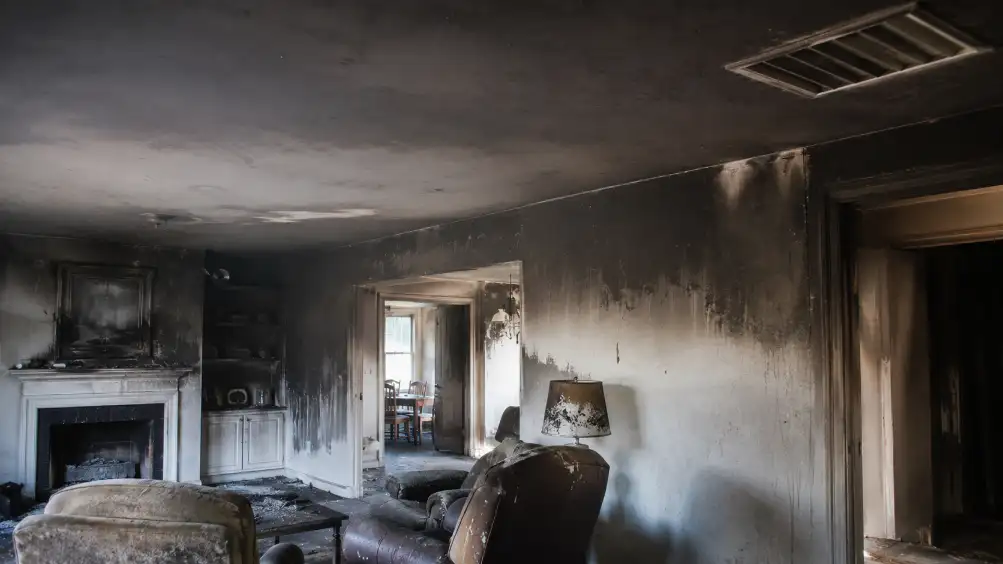
Smoke and soot can enter air ducts after a house fire, especially when the heating or cooling system operates during the fire or shortly afterward. Smoke may move through return-air openings, filters, supply registers, ductwork, air handlers, furnaces, and other mechanical pathways. Residue may also collect around vents even when the fire occurred in a different room.
HVAC involvement does not mean that every duct system automatically requires complete cleaning or replacement. The appropriate response depends on where the fire occurred, what burned, whether the system was running, how smoke traveled, the type of ductwork, visible residue, odor, water exposure, and the condition of the mechanical equipment.
Do not turn on a fire-affected heating or cooling system simply to test whether the smoke smell is gone. Operating the equipment before inspection may redistribute odor and particles into rooms that were previously less affected. The property, HVAC system, filters, vents, and surrounding building materials should be evaluated as part of the complete fire and smoke restoration plan.
Quick Answer
Smoke damage in air ducts may be present when odor becomes stronger as the HVAC system runs, soot is visible around registers or returns, the filter contains dark residue, or rooms far from the fire smell smoky. Keep the system off until it has been professionally evaluated. Replacing the filter alone may not address residue on vents, equipment, duct surfaces, insulation, or smoke-damaged materials elsewhere in the property.
Key Takeaways
- Smoke may enter HVAC pathways when the system operates during or after a fire.
- Return-air openings can draw smoke and particles from affected rooms into the system.
- Visible soot around one vent does not show the complete extent of contamination.
- A new filter may help with future filtration but does not remove residue already deposited elsewhere.
- Smoke odor from vents can also originate from contaminated walls, insulation, carpet, cabinets, or contents.
- Flexible ducts, lined ducts, sheet-metal ducts, filters, coils, and mechanical equipment require different evaluations.
- Fire residue should be removed at its source before relying on filtration or deodorizing.
- The HVAC system should not return to normal use until fire, electrical, smoke, and water concerns have been addressed.
Table of Contents
- How smoke enters an HVAC system
- Which HVAC components may be affected
- Signs of smoke damage in air ducts
- Should you run the HVAC system after a fire?
- Why different fires create different residues
- Is replacing the HVAC filter enough?
- Does every fire require air-duct cleaning?
- What to do after suspected HVAC smoke damage
- Mistakes to avoid
- How professional HVAC inspection and restoration work
- What may be cleaned or replaced
- How long the work may take
- Why smoke odor may return
- Insurance documentation considerations
- Northern Illinois and Southern Wisconsin considerations
- Frequently asked questions
How Does Smoke Enter an HVAC System?
Smoke moves according to heat, pressure, air currents, building openings, and mechanical airflow. Hot smoke initially rises, but it can spread horizontally and move into cooler rooms as conditions change.
If a forced-air heating or cooling system operates during the fire, return-air openings may draw smoke from affected rooms. The system can then move contaminated air through filters, equipment, ductwork, and supply registers.
Smoke may reach HVAC components through:
- Return-air grilles in the room where the fire occurred
- Open supply registers and floor vents
- Gaps around duct connections and mechanical penetrations
- Shared wall, ceiling, attic, basement, or crawl-space cavities
- An open furnace or air-handler compartment
- Damaged, missing, or improperly fitted HVAC filters
- Leaking return ducts that draw air from affected spaces
- Smoke movement through hallways and connected rooms
- Firefighting openings made in walls or ceilings
Smoke can also settle on the exterior of registers and nearby walls without entering deeply into the duct system. Visible residue around a vent should therefore be evaluated rather than treated as proof that every section of ductwork is contaminated.
Return-Air Openings Can Draw Smoke Into the System
Return-air grilles pull room air back toward the furnace or air handler. When smoke is present and the HVAC blower is operating, the return pathway may carry smoke toward the filter and mechanical equipment.
The filter may capture part of the particulate material, but performance depends on its design, condition, fit, efficiency, and the size and characteristics of the particles.
Some particles and odor-producing compounds may pass through or around the filter. Residue can then deposit on internal surfaces or move toward supply ducts and other rooms.
Smoke May Travel Even When the HVAC System Is Off
An operating blower can increase smoke movement, but smoke may also enter open vents and ducts through natural pressure differences, convection, air leakage, and movement within the building.
A system that was off during the fire may still require inspection when soot is visible around vents, odor comes from registers, or the fire occurred close to the furnace, air handler, return grille, or exposed ductwork.
Which HVAC Components May Be Affected by Smoke and Soot?
An HVAC system includes more than the visible supply registers. Depending on the building and equipment, inspection may include several connected components.
| Component | Possible Fire or Smoke Impact | Restoration Consideration |
|---|---|---|
| Return-air grilles | Soot deposits, staining, odor, and smoke drawn from affected rooms | May require removal and material-specific cleaning or replacement |
| HVAC filter | Smoke particles, soot, odor, ash, and airflow restriction | Usually replaced after documentation and evaluation rather than cleaned and reused |
| Furnace or air handler | Residue on internal surfaces, electrical damage, heat exposure, odor, or firefighting water | Requires evaluation by qualified restoration and HVAC professionals |
| Blower assembly | Particle deposits, odor, corrosion, or reduced performance | Accessibility and equipment condition determine whether cleaning, repair, or replacement is appropriate |
| Evaporator coil | Fine residue collecting on coil surfaces and surrounding components | Cleaning must avoid damaging fins, coatings, controls, and refrigerant components |
| Sheet-metal ductwork | Surface deposits, smoke odor, ash, and residue at seams or transitions | May be cleanable when accessible and structurally sound |
| Internally lined ducts | Residue and odor entering porous or fibrous lining | The lining condition and depth of contamination affect whether it can be retained |
| Flexible ducts | Residue inside flexible material, damage from heat, and odor in insulation | Replacement may be more practical when the material is damaged or cannot be effectively restored |
| Supply registers | Deposited soot, staining, odor, and redistribution into rooms | May be cleaned or replaced according to material and condition |
| Duct insulation | Smoke odor, soot, heat damage, or firefighting water | Porous insulation may require removal when contaminated or damaged |
Surrounding Building Materials Also Matter
Odor near an air vent does not always originate inside the duct. Drywall, ceiling materials, insulation, framing, carpet, cabinets, furnishings, and contents surrounding the register may hold smoke residue.
An HVAC system may redistribute odor from those materials even when the duct interior is not the primary source. Professional assessment should therefore include the room and surrounding building materials, not only the duct opening.
What Are the Signs of Smoke Damage in Air Ducts?
Possible warning signs include:
- Smoke odor becomes stronger when the furnace or air conditioner operates
- Rooms far from the original fire begin smelling smoky
- Black, gray, brown, or oily residue appears around vents or returns
- The HVAC filter contains visible soot or an unusual smoke odor
- Particles appear near supply registers after the system runs
- Odor returns after walls and contents have been cleaned
- The fire occurred near a return grille, furnace, air handler, or exposed duct
- The HVAC system operated during the fire
- Firefighting water entered vents, mechanical equipment, or duct pathways
- Flexible ducts or insulation show heat, soot, or water damage
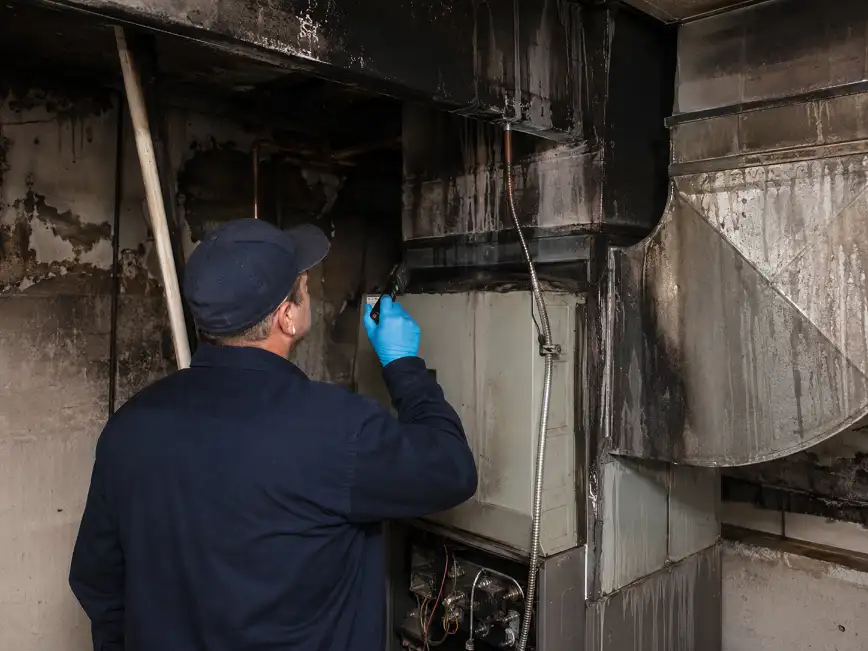
These warning signs indicate possible HVAC involvement, but they do not determine the full scope by themselves. Visible residue may be limited to a register, or contamination may extend into connected components that cannot be seen from the room.
Odor That Returns When the System Runs Is Important
If the property smells better while the HVAC system is off but smoke odor returns when airflow begins, the system or surrounding air pathways should be evaluated.
The source could include a contaminated filter, return-air pathway, blower compartment, duct lining, insulation, register, or smoke-damaged material elsewhere in the building.
McMahon Services discusses this warning sign in its guide to lingering smoke odor after a fire.
Visible Soot Near a Vent Does Not Show the Complete Boundary
Soot around a register may have deposited from smoke moving through the room rather than from inside the duct. It may also indicate that smoke traveled through the HVAC system.
The direction of staining, location of the fire, operating condition of the HVAC equipment, filter condition, duct layout, and residue inside accessible components all help determine the likely pathway.
Should You Run the HVAC System After a House Fire?
Do not operate an HVAC system affected by fire, smoke, heat, soot, or firefighting water until it has been professionally evaluated.
Running the system too soon may:
- Move smoke odor into additional rooms
- Redistribute loose soot and particles
- Draw contamination farther into return-air pathways
- Spread residue from a smoke-damaged filter
- Operate equipment with water or electrical damage
- Move odor from smoke-damaged building materials
- Make it more difficult to determine the original damage boundary
Do not reset breakers, replace the filter, and start the system simply to see whether it still works. Fire heat, smoke residue, water, damaged wiring, and contaminated components may create problems that are not visible from the thermostat.
Temporary Heating or Cooling May Require a Separate Plan
During Northern Illinois winters or hot summer conditions, the property may require temperature control while the permanent HVAC system remains unavailable.
Temporary heating, cooling, ventilation, or dehumidification should be planned with restoration, electrical, fire-safety, and building professionals. Unapproved heaters or fans can create additional fire, electrical, moisture, and contamination concerns.
Why Do Different Fires Affect HVAC Systems Differently?
The characteristics of smoke depend on the materials that burned, fire temperature, oxygen availability, and whether the fire was fast-burning or smoldering.
| Fire Source or Condition | Possible Residue | HVAC Concern |
|---|---|---|
| Fast-burning wood or paper fire | Fine, dry, powder-like particles | Loose particles may travel through returns, filters, vents, and accessible duct surfaces |
| Slow, smoldering upholstery fire | Oily, sticky residue with persistent odor | Residue may adhere to equipment and porous duct materials |
| Kitchen or protein fire | Thin, sometimes nearly invisible film with strong odor | Odor may persist even when heavy black soot is not visible |
| Plastic or synthetic-material fire | Dark, oily, chemical residue | Cleaning procedures must account for the materials and residue involved |
| Furnace or fuel-related incident | Oily soot distributed near or through mechanical pathways | Mechanical equipment may be close to the residue source and require detailed evaluation |
A home may contain several residue types after one fire. The room where the fire started may have oily deposits, while distant rooms and vents contain lighter particulate residue.
One cleaner or one duct-cleaning procedure should not automatically be applied to every surface, material, and component.
Is Replacing the HVAC Filter Enough After a Fire?
Replacing a smoke-affected filter is often necessary, but it is not always sufficient. The filter is only one component within the heating and cooling system.
Residue may already be present on:
- Return-air grilles
- The filter rack and surrounding cabinet
- The blower assembly
- Coils and internal equipment surfaces
- Supply and return duct surfaces
- Duct insulation or lining
- Registers and diffusers
- Walls, ceilings, carpet, furniture, and contents near the vents
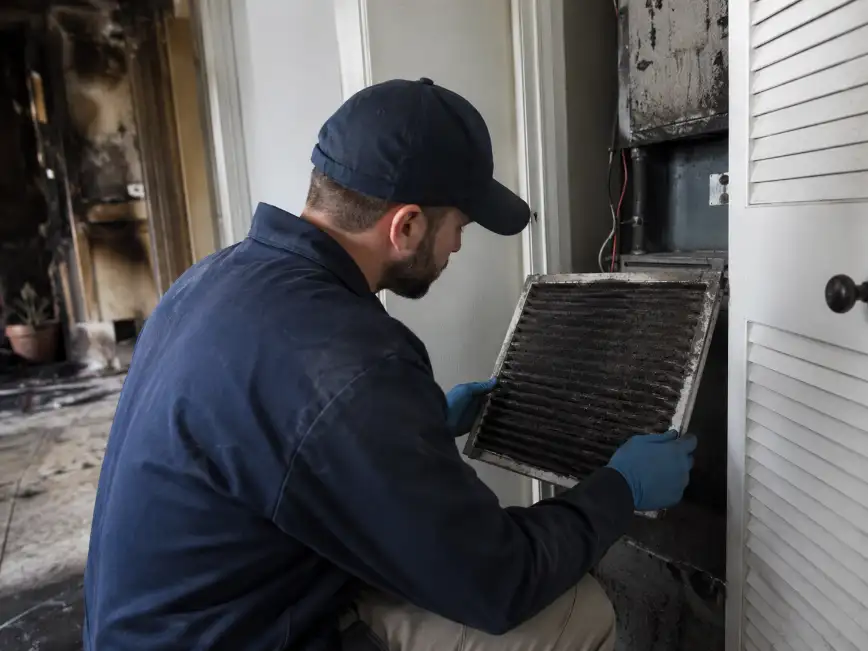
A new filter helps filter air during future system operation. It does not remove soot that has already settled on equipment, ducts, registers, insulation, or building materials. It also does not correct heat, corrosion, electrical, odor, or firefighting-water damage.
The U.S. Environmental Protection Agency explains that filtration can support source control and ventilation, but filters and portable air cleaners do not remove every indoor pollutant. After a fire, the residue and damaged materials producing the pollution should be addressed rather than relying only on filtration.
Review the EPA guidance on air cleaners and HVAC filters.
Do Not Upgrade the Filter Without Checking System Compatibility
A higher-efficiency filter may create more airflow resistance than some systems are designed to handle. Filter selection should match the equipment, filter rack, blower capacity, and manufacturer requirements.
A qualified HVAC professional can determine the appropriate filter after the system has been inspected, cleaned, repaired, and cleared for operation.
Does Every House Fire Require Air-Duct Cleaning?
No. Not every fire requires complete air-duct cleaning. The decision should follow inspection and assessment rather than being based only on the presence of smoke somewhere in the home.
Professional Duct Cleaning May Be More Appropriate When:
- The HVAC system operated while smoke was present
- Visible soot or residue is found inside accessible duct surfaces
- The filter and return pathway contain significant smoke residue
- Smoke odor becomes stronger when the system operates
- Smoke moved into rooms far from the fire through mechanical airflow
- The fire occurred near the furnace, air handler, or major return
- Firefighting water or debris entered the duct system
- Registers, duct lining, or insulation remain contaminated after surrounding surfaces are cleaned
Cleaning May Be Unnecessary or Limited When:
- The fire was very small and isolated
- The HVAC system remained off
- Inspection finds no residue inside the system
- Odor originates from another affected material
- Only removable registers require cleaning
- The filter and mechanical components remained protected
The assessment should distinguish between residue on the exterior of a vent, contamination within a connected air pathway, and odor moving from smoke-damaged materials elsewhere in the property.
McMahon Services provides professional air-duct and carpet cleaning services that may support broader restoration when smoke residue affects vents, ducts, carpeting, and indoor surfaces.
What Should You Do After Suspected HVAC Smoke Damage?
-
Wait until the property is safe to enter.
Do not enter a fire-damaged structure until authorized by fire officials or other qualified professionals.
-
Leave the HVAC system off.
Do not operate the furnace, air conditioner, heat pump, blower, ventilation fan, or whole-house air cleaner until the system has been evaluated.
-
Document visible conditions.
Photograph soot near vents, stained registers, the HVAC filter, damaged equipment, wet components, and affected rooms when it is safe to do so.
-
Note when and where odor appears.
Record whether the odor is stronger near returns, supply registers, the furnace, basement, attic, or specific rooms.
-
Do not remove the filter before documentation when practical.
The filter condition may help show whether smoke entered the return pathway. Follow professional and insurance instructions before disposal.
-
Limit movement through affected areas.
Shoes, clothing, tools, and cleaning materials can transfer soot into cleaner rooms and mechanical spaces.
-
Arrange a complete fire and smoke inspection.
The assessment should include affected rooms, building materials, contents, vents, filters, HVAC pathways, smoke odor, and firefighting water.
-
Use qualified specialists when necessary.
Fire restoration technicians, HVAC contractors, electricians, duct-cleaning professionals, and reconstruction contractors may all be involved depending on the damage.
Safety Warning: Do not turn on fire-affected HVAC equipment, reset electrical breakers, touch wet mechanical components, or open equipment panels unless you are qualified and authorized to do so.
What Mistakes Should You Avoid?
- Do not turn on the blower to air out the house. This may redistribute particles and smoke odor.
- Do not assume a new filter solves the entire problem. Residue may remain on equipment, ducts, vents, insulation, and building materials.
- Do not spray fragrances into vents. Odor masking does not remove soot or smoke residue.
- Do not wipe oily soot with an ordinary wet cloth. The residue may smear and stain painted or finished surfaces.
- Do not use an ordinary household vacuum inside vents. Fine particles may pass through the machine or become airborne.
- Do not clean only the visible duct openings. Registers may be only one part of the affected system.
- Do not replace ducts without confirming the damage boundary. Some components may be cleanable, while others may not be affected.
- Do not perform reconstruction before smoke sources are addressed. New finishes can conceal odor-producing residue.
- Do not ignore firefighting water. Wet insulation, equipment, ceilings, or duct materials may require drying or removal.
How Does Professional HVAC Inspection and Smoke Restoration Work?
The ANSI/IICRC S700 fire and smoke damage restoration standard addresses the assessment of fire residue and odor affecting buildings, contents, and building systems such as HVAC equipment.
Review the ANSI/IICRC S700 fire and smoke restoration standard overview.
1. Property Safety Assessment
Professionals first evaluate structural stability, electrical hazards, damaged utilities, fire debris, hot spots, and water exposure.
The HVAC system remains off until qualified professionals determine that inspection can proceed safely.
2. Fire and Smoke Boundary Assessment
The restoration team identifies the fire location, materials that burned, smoke pathways, residue types, affected rooms, and possible HVAC involvement.
Understanding where smoke traveled helps determine which returns, supplies, ducts, and equipment require inspection.
3. HVAC Operating-History Review
Property owners, occupants, firefighters, thermostat records, and system controls may help establish whether the furnace, air conditioner, blower, or ventilation system operated during or after the fire.
This information does not replace physical inspection, but it helps identify possible smoke-movement pathways.
4. Filter and Return-Air Inspection
The filter, return grilles, return plenum, filter rack, and accessible return pathways are evaluated for soot, ash, odor, moisture, and damage.
The filter may be photographed and retained temporarily for documentation before replacement or disposal.
5. Mechanical Equipment Evaluation
A qualified HVAC contractor may inspect the furnace, air handler, blower, coils, controls, electrical components, heat exchanger, insulation, cabinet, and accessible internal surfaces.
Heat, water, corrosion, or electrical damage may require repair or replacement even when visible smoke residue appears limited.
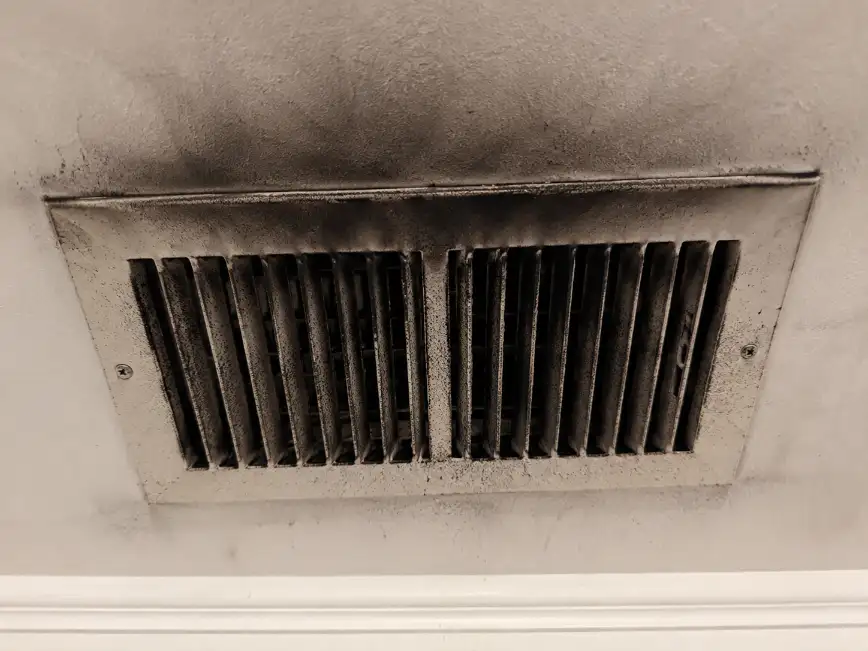
6. Duct and Register Inspection
Accessible supply and return ducts, registers, diffusers, transitions, flexible ducts, and lined duct materials are evaluated.
The construction, accessibility, and condition of the ductwork influence whether cleaning is practical or whether damaged sections require replacement.
7. Source Removal Throughout the Property
Cleaning the HVAC system alone will not solve an odor problem when soot remains on walls, ceilings, carpet, cabinets, upholstery, insulation, and contents.
Smoke-damaged materials are cleaned or removed according to their condition and ability to be restored.
McMahon Services explains the broader restoration sequence in Smoke Damage in Your Home: What Should You Do Next?.
8. HVAC and Air-Duct Cleaning When Indicated
Cleaning procedures are selected according to the system design, residue type, duct material, accessibility, and contamination level.
Registers may be removed for cleaning. Accessible metal duct surfaces and mechanical components may require specialized equipment and methods. Porous or damaged duct materials may require a different response.
9. Filter Replacement
The smoke-affected filter is replaced with a filter appropriate for the equipment. Additional filter changes may be recommended during restoration when airborne particles remain in the work environment.
10. Odor Management
Odor treatment follows cleaning and source removal. Air cleaning and deodorizing may support the process, but they should not replace removal of soot and smoke-damaged materials.
11. Cleaning and System Verification
The property and HVAC system are reevaluated before normal use resumes. Professionals may check visible cleanliness, remaining odor, equipment operation, filter condition, airflow, and whether additional repairs are required.
12. Repairs and Reconstruction
Fire damage may require replacement of insulation, flexible ducts, drywall, ceilings, flooring, cabinets, framing, electrical components, or mechanical equipment.
McMahon Services provides cleanup and rebuilding after major property damage when smoke restoration must be followed by permanent construction repairs.
Which HVAC Materials Can Be Cleaned or May Need Replacement?
Cleaning May Be More Appropriate When:
- The component remains structurally and mechanically sound
- Residue is accessible and primarily on a cleanable surface
- The material can tolerate the selected cleaning method
- There is no significant heat, electrical, corrosion, or water damage
- Smoke odor can be removed successfully
- Cleaning will not damage coatings, insulation, seals, controls, or equipment performance
Replacement May Be More Appropriate When:
- Flexible duct material is melted, brittle, torn, or heavily contaminated
- Internal duct lining holds persistent residue or odor
- Duct insulation is wet, smoke-damaged, or contaminated
- Electrical controls or wiring were affected by heat or water
- Mechanical equipment sustained fire or corrosion damage
- Cleaning cannot reach the affected material effectively
- The component cannot be restored without compromising safety or performance
The decision should be based on inspection, manufacturer requirements, material condition, system performance, accessibility, and the overall fire restoration plan.
How Long Does HVAC Smoke Restoration Take?
There is no universal timeline. A minor contained fire may require filter replacement, register cleaning, limited inspection, and room-level smoke cleanup. A larger fire may require extensive contents cleaning, structural restoration, duct inspection, equipment repair, water removal, and reconstruction.
| Timeline Factor | Why It Matters |
|---|---|
| Fire size and location | A fire close to a return, furnace, or air handler may require a broader mechanical assessment. |
| HVAC operating status | A running blower may have moved smoke through more of the system. |
| Duct construction | Metal, flexible, lined, and insulated ducts require different evaluation and restoration methods. |
| Residue type | Dry, oily, protein-based, and mixed residues may require different cleaning procedures. |
| Mechanical damage | Heat, water, electrical, and corrosion damage may require specialist repairs or replacement equipment. |
| Property-wide smoke damage | Walls, ceilings, contents, carpet, insulation, and cabinets may need cleaning before odor can be controlled. |
| Firefighting water | Wet equipment, insulation, ducts, ceilings, and walls add extraction and drying stages. |
A reliable timeline should be based on inspection findings, cleaning results, equipment condition, structural drying progress, repair needs, and final verification rather than a fixed number of days.
Why Can Smoke Odor Return After Duct Cleaning?
Smoke odor may return when the duct system was not the only source. Fire residue may remain in carpet, padding, upholstery, cabinets, drywall, ceiling materials, insulation, framing, contents, or wall cavities.
Other possible reasons include:
- A contaminated HVAC filter was not replaced
- The return-air pathway or mechanical equipment was not included in the cleaning scope
- Porous duct lining or insulation retains odor
- Smoke-damaged materials remain elsewhere in the property
- Heat or humidity changes release odor from porous materials
- Firefighting water remains in building materials
- Cleaning or deodorizing was incomplete
Air fresheners, scented sprays, candles, and fragrances may cover odor temporarily. They do not remove the soot or smoke-damaged materials responsible for the smell.
The EPA identifies source control as one of the most effective strategies for improving indoor air quality. Filtration and ventilation can support the process, but the pollution source should be removed or reduced whenever practical.
Review the EPA guidance for improving indoor air quality.
What Should You Document for an Insurance Claim?
Insurance coverage and claim procedures vary. When the property is safe to enter, document possible HVAC involvement before major cleaning, disposal, or replacement changes the condition.
Useful documentation may include:
- The room and location where the fire started
- Whether the HVAC system was operating
- Soot or staining around supply registers and returns
- The condition of the HVAC filter
- Odor near vents, equipment, and distant rooms
- Fire, heat, smoke, and water damage near mechanical equipment
- Damaged flexible ducts, insulation, controls, or wiring
- Professional fire-restoration and HVAC inspection reports
- Air-duct cleaning, filter, equipment, and repair estimates
- Photographs before and after registers or components are removed
- Cleaning records and replaced-component documentation
- Temporary heating, cooling, storage, or housing expenses
Do not discard filters or damaged HVAC parts before documentation unless immediate removal is necessary for safety. Ask the insurance carrier what records and inspections it requires.
McMahon Services provides additional guidance in Fire or Water Damage Cleanup: 7 Things to Document.
Why HVAC Smoke Damage Matters in Northern Illinois and Southern Wisconsin
Homes and businesses in Hainesville, Lake County, Northern Illinois, Southern Wisconsin, and surrounding communities may rely heavily on forced-air heating during long periods of cold weather.
If a fire occurs during winter, the heating system may have been operating when smoke developed. The property may also require temporary heating while the furnace, air handler, ducts, electrical system, and fire-damaged building materials are inspected.
Cold-weather fire recovery can become more complex when:
- The furnace cannot be operated safely
- Broken windows or roof openings expose the building to freezing air
- Water from fire suppression affects mechanical rooms or duct insulation
- Disconnected utilities increase the risk of frozen plumbing
- Temporary heat is needed for structural drying and property protection
- Smoke odor remains inside a closed building with limited natural ventilation
Summer fires create different concerns when air conditioning and indoor humidity control are unavailable. Firefighting water, high humidity, wet insulation, and closed rooms can add structural drying and mold-prevention requirements.
Professional Tip: Do not judge HVAC smoke damage only by looking into one floor register. The filter, return pathway, equipment, duct construction, surrounding insulation, operating history, and smoke-damaged rooms must be considered together.
Get Help With Smoke Damage in Air Ducts
Smoke damage in air ducts can be difficult to evaluate because the visible register represents only a small part of the complete heating and cooling system.
McMahon Services & Construction Corp provides 24/7 fire and smoke damage restoration services for homes and businesses affected by soot, smoke odor, damaged contents, HVAC pathways, firefighting water, and structural damage.
The restoration process may include property inspection, soot cleaning, smoke-odor source removal, contents handling, HVAC pathway evaluation, water extraction, structural drying, air-duct cleaning, damaged-material removal, and reconstruction.
McMahon Services also provides air-duct and carpet cleaning services when vents, ductwork, carpeting, and interior surfaces require professional cleaning as part of a broader restoration project.
Call McMahon Services at (847) 566-4568 for 24/7 fire, smoke, soot, and HVAC-related restoration assistance throughout Hainesville, Lake County, Northern Illinois, Southern Wisconsin, and surrounding service areas.
Frequently Asked Questions About Smoke Damage in Air Ducts
Can smoke enter air ducts even when the HVAC system is off?
Yes. Smoke may enter open vents and duct pathways through natural air movement, pressure differences, convection, and gaps around the system. Operating equipment can increase distribution, but an inactive system may still require inspection when residue or odor is present.
How can I tell whether soot entered my ductwork?
Possible signs include visible residue inside accessible vents, a dark or smoke-affected filter, odor that becomes stronger when the system operates, and smoke smells appearing in rooms far from the fire. Professional inspection is needed to confirm the extent.
Should I replace the HVAC filter after a house fire?
A smoke-affected filter commonly requires replacement, but changing the filter alone does not remove soot from equipment, registers, duct surfaces, insulation, or smoke-damaged building materials. The system should be evaluated before normal operation resumes.
Does every house fire require professional air-duct cleaning?
No. The need depends on the fire location, whether the HVAC system operated, visible residue, odor, duct construction, filter condition, and inspection findings. Some fires require limited cleaning, while others affect multiple system components.
Can I run the furnace or air conditioner to remove smoke odor?
No. Do not operate fire-affected HVAC equipment without professional clearance. Running the system may redistribute particles and odor or operate equipment affected by heat, water, soot, corrosion, or electrical damage.
Why does my home smell smoky when the HVAC system runs?
Smoke residue may remain in the filter, returns, ducts, equipment, registers, insulation, or nearby building materials. Airflow can move odor from these sources through the property even after visible surfaces have been cleaned.
Can flexible air ducts be cleaned after smoke damage?
It depends on the duct material, accessibility, residue, odor, and whether the duct was damaged by heat or water. Replacement may be more practical when flexible duct material or its insulation is heavily contaminated, melted, torn, or unable to be restored.
Who should inspect an HVAC system after a fire?
A fire and smoke restoration contractor can assess property-wide residue and odor, while a qualified HVAC professional can evaluate mechanical operation, electrical components, ducts, filters, coils, and equipment. Other specialists may be needed when water, structural, or electrical damage is present.




0 Comments